

NobleSeals
William the Conqueror, Duke of Normandy - Enthroned Seal - 1069 - Historical Wax Seal Stamp
William the Conqueror, Duke of Normandy - Enthroned Seal - 1069 - Historical Wax Seal Stamp
Couldn't load pickup availability
William the Conqueror, Enthroned Great Seal - 1069 - Historical Wax Seal Stamp
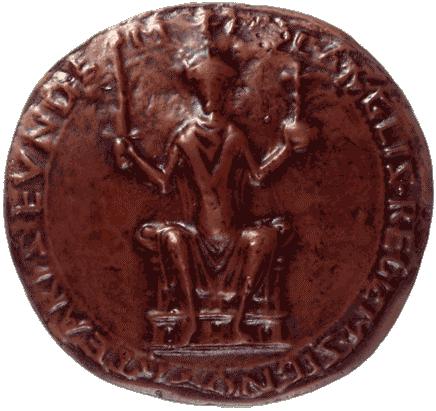
Wax seal stamp based on the enthroned face of the Great Seal of William I, better known as William the Conqueror, dating from the first years of Norman rule in England.
William was Duke of Normandy from 1035 and became King of England following the Norman Conquest of 1066. After his victory at Hastings, he was crowned at Westminster Abbey on Christmas Day 1066, beginning a reign that fundamentally reshaped the government, aristocracy and culture of medieval England.
William’s Great Seal is particularly important because its two faces deliberately represent his two principal identities.
The Norman face depicts William mounted and armed as Duke of Normandy, while this face presents him seated in majesty as King of England.
William is shown frontally upon his throne, crowned and holding the traditional symbols of royal authority. The composition follows an established European tradition of portraying a sovereign enthroned, emphasising government, law and legitimate kingship rather than the military character of the equestrian face.
The contrast between the two images was intentional. On one face William appears as the mounted Norman ruler from whom his hereditary authority derived; on the other he appears as the crowned King of the English whose position had been established following the events of 1066.
The Great Seal was more than a royal portrait. Attached to important charters and grants, it authenticated documents issued in the king’s name and provided a visible representation of royal authority in an age when relatively few people would ever see the monarch personally.
The seal is also especially significant because it predates the developed system of hereditary heraldry. William is represented through royal regalia, inscription and personal imagery rather than through the formal coats of arms that became characteristic of later medieval monarchs.
Seal Legend:
+ HOC ANGLIS REGEM SIGNO FATEARIS EVNDEM
Expanded Latin:
Hoc Anglis regem signo fatearis eundem.
Translation:
“By this sign acknowledge the same man as King of the English.”
The word “eundem” — “the same man” — refers directly to the figure shown on the opposite face of the seal.
The equestrian Norman face bears:
+ HOC NORMANNORVM WILLELMVM NOSCE PATRONVM SI
The two legends were designed to be read together, giving the approximate complete sense:
“By this sign know William as lord of the Normans; by this other sign acknowledge the same man as King of the English.”
This pairing makes William’s seal particularly remarkable: the inscription itself links the two sides and presents Normandy and England as the two complementary aspects of his authority.
Design: Enthroned Great Seal of William I
Person: William I / William the Conqueror
Title represented: King of England
Dynasty: Norman
Date: 1069
Reign: 1066–1087
Period: 11th-century England
Original Seal Size: approximately 85 mm
Stamp Size: 50 mm
Material: Solid brass
Type: Wax seal stamp / sealing stamp
Each stamp is made of solid brass, supplied with a handle, and presented in a velvet pouch.
Suitable for letters, envelopes, medieval collections, Norman history displays, genealogy projects, traditional stationery and decorative sealing.
Share