

NobleSeals
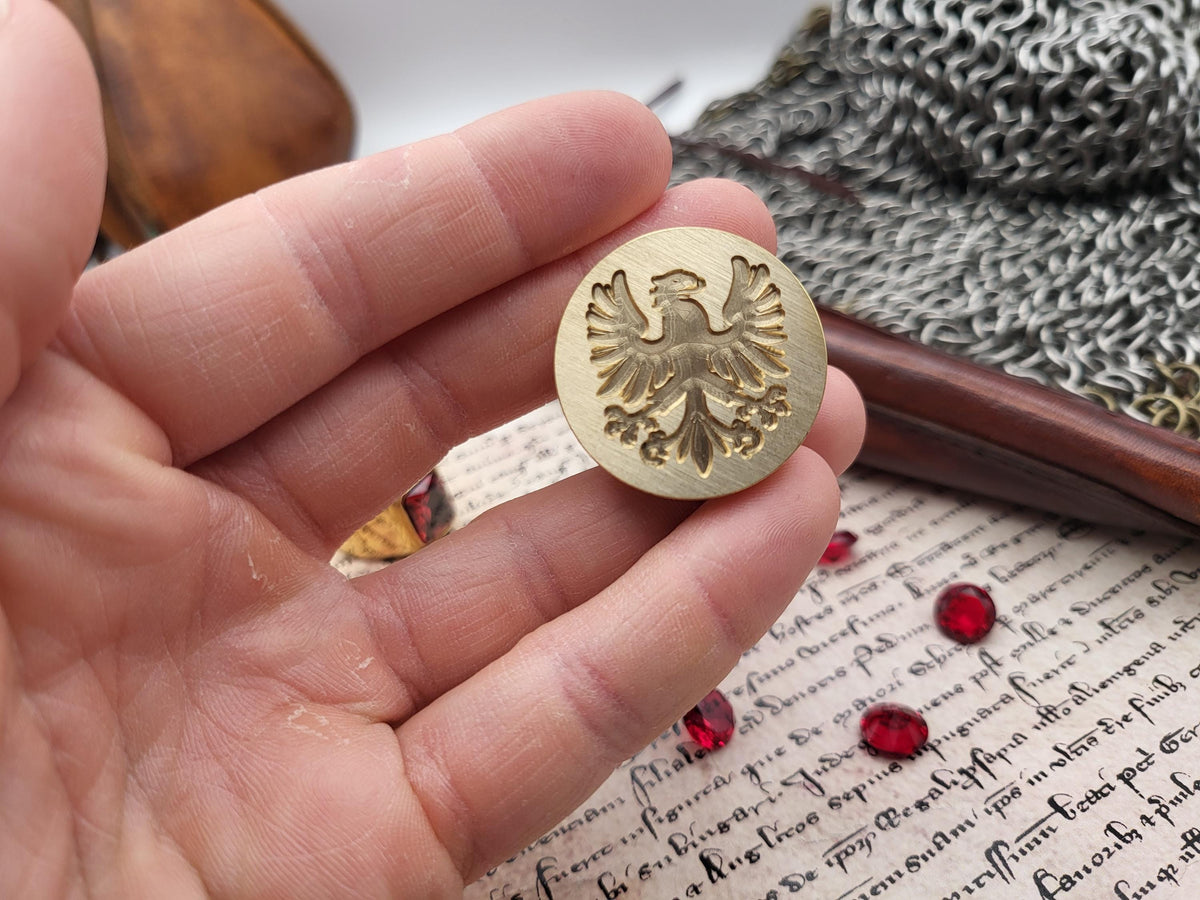
Polish People’s Republic Eagle, Piast Eagle - 1952–1989 - Contemporary Wax Seal Stamp
Polish People’s Republic Eagle, Piast Eagle - 1952–1989 - Contemporary Wax Seal Stamp
Couldn't load pickup availability
Polish People’s Republic Eagle, Uncrowned White Eagle - 1952–1989 - Contemporary Wax Seal Stamp
Wax seal stamp featuring the White Eagle of Poland, one of the oldest and most enduring national and heraldic symbols in Europe.
Eagle imagery was used by rulers of the Piast dynasty from the early medieval period, appearing on Polish coins, seals, shields and banners. Early forms varied considerably, but during the 13th century the eagle developed into an increasingly recognisable dynastic and territorial emblem.
A major turning point came with the coronation of Przemysł II as King of Poland in 1295. His surviving royal seal is particularly important because its reverse bears a crowned eagle on a Gothic shield. This is regarded as the first surviving use of the crowned White Eagle in the role of the coat of arms of the Kingdom of Poland.
Following Przemysł II's death in 1296, the emblem continued to be used by subsequent rulers. It was permanently restored as the principal royal emblem under Władysław I Łokietek following his coronation in 1320, after which the crowned eagle remained at the heart of Polish heraldry.
Over the following centuries the appearance of the eagle changed with artistic fashion and different royal dynasties. Under the Jagiellonian kings it became more slender and elaborate, while later rulers sometimes incorporated their own dynastic arms into the composition. Despite these changes, the crowned White Eagle remained the principal heraldic emblem associated with Poland.
The design therefore represents a heraldic tradition stretching back more than seven centuries, with its medieval form closely associated with the restoration of the Polish monarchy under the later Piast rulers.
A major alteration occurred following the WW II, when the crown was removed from the eagle. The Polish People’s Republic was formally established under the Constitution of 22 July 1952, which defined the state emblem as a white eagle without its traditional crown.
The design retained much of the appearance of the White Eagle created by artist Zygmunt Kamiński in 1927 for the earlier Republic of Poland. Rather than replacing the historic eagle completely, the post-war version largely preserved Kamiński’s distinctive stylised form while removing the crown from its head.
The official appearance of the emblem was further regulated by the decree of 7 December 1955 concerning the emblem, colours and state seals of the Polish People’s Republic.
For nearly four decades the uncrowned eagle appeared on official documents, government buildings, coins, state seals and other symbols of public administration. Despite the removal of the crown, the design remained immediately recognisable as the historic Polish White Eagle.
Following the political changes of 1989, the traditional golden crown was restored to the eagle. On 29 December 1989 the state’s name was changed back to the Republic of Poland and the crowned White Eagle once again became the official national emblem.
Design: Uncrowned White Eagle
State: Polish People’s Republic
Date: 1952–1989
Period: 20th-century Poland
Original Design Basis: Zygmunt Kamiński, 1927
Official Form: 1952 Constitution / 1955 State Emblem Decree
Stamp Size: 30 mm
Material: Solid brass
Type: Wax seal stamp / sealing stamp
Each stamp is made of solid brass, supplied with a handle, and presented in a velvet pouch.
Suitable for letters, envelopes, historical collections, Polish heritage displays, heraldry collections, genealogy projects, traditional stationery and decorative sealing.
Share